Question 1
1.1 The Nine Elements of Digital Citizenship
Digital access
Digital access is about how people in society get hold of and use technology.
Digital access opportunities will increase the knows-how of the general public. For example, the presence of information and communications technology impacted the 2010 Arab Springs, where people of repressive countries used social media to gain support and plan for demonstrations, which ultimately contributed to the toppling of various governments
Lack of access to technology is known as the ‘digital divide’, or sometimes referred to as those that have access to technology and those do not have access to technology (The IIE, 2019).
Digital Commerce
Digital commerce (d-commerce) incorporates the technological purchasing and selling of goods and services through technological networks.
Following the introduction of Electronic Data Interchange (EDI) and Secure Socket Layer protocol, however, d-commerce has grown into a combination of purchasing, selling, developing, marketing and servicing of products.
D-commerce makes use of all digital channels to provide the
platform and space for transactions and is not solely Internet based (The IIE, 2019).
Digital Communication
Digital communication is the technological transfer of information. Basically, it is communication that has been encrypted digitally to aid the transmission for exchange, allowing it to be stored and processed by computers.
Today we have communication methods fluctuating from online face-to-face covering vast distances using Voice over Internet Protocols, such as Skype, to written communication, be it simultaneous, such as instant messaging, or separate, such as email (The IIE, 2019).
Digital Literacy
Digital Literacy is the aptitude to utilise information and communication technologies to discover, evaluate, craft and communicate content, requiring both cognitive and technical skills (The IIE, 2019).
According to Visser (2012), some of the sills a digitally literate person would possess are: understanding the relationship between the technology used, life-long learning, privacy and the responsible use of information; being able to use a wide variety of technology in an appropriate and effective manner; and possessing technical and intellectual skills.
Digital Etiquette
Digital etiquette, or netiquette, is an uncomplicated set of rules relating to behaviour and good manners that needs to be adhered to, if the Internet is going to be better for all users.
When Communicating online, or in the written form, words become the sole medium of communication and thus misunderstandings can occur without non-verbal signals (The IIE, 2019).
According to Shea (1994), an academic who has been dubbed the ‘network manners guru’, some of these guidelines are: remember the human, never forget that the person reading your communication, and adhere to the same standards of behaviour online that you follow in real life.
Digital Law
Digital law is known as the technological accountability for actions, which are either ethical or unethical.”
We have seen some laws put in place affecting society laws on privacy, cyber stalking, and cyber-terrorism (The IIE, 2019).
But, according to J. Sookha (4 September 2019), digital law is still in its infancy and not every country has laws in place to protect people online. Cookies effectively store information about preferences, keywords of terms you previously searched, and sites you’ve visited.
Digital Rights and Responsibilities
Digital rights and responsibilities are the privileges and independence given to all digital technology users.
With every right there is also a responsibility. And rights and responsibilities are connected because with every right (such as freedom of speech), there is a responsibility to not abuse the right.
Digital Health and Wellness
Digital Health and Wellness refers to the bodily and mental wellbeing in an electronical society.
A method to avert risks and provide protection is via education and training. Children should be taught to look out for the various symptoms and signs of anything that can impact their wellbeing.
We are in the stage of generational adoption, where we have users of digital technology that did not grow up with the Internet. Therefore, technological education also needs to address the issues that adults may encounter (The IIE, 2019).
Digital Security
It is about the safeguards people take to ensure digital safety.
Digital security issues do not just relate to big corporates but affect the general public as well. Scams, identity theft, stalking, harassment and cyber-bullying are just some of the security issues the general public is facing (The IIE, 2019).
Question 1.2
Social capital is about specific benefits that are achieved from the use of social networks, such as a sense of belonging, reciprocity, feelings of trust and safety, diversity, and co-operation.
Basically it generates worth for people who are connected to each other. Users who engage and collaborate with social media tools – such as Facebook, Twitter and LinkedIn – are in fact building social capital.
In addition to building our social capital we are increasing our social and communication skills (The IIE, 2019).
According to J. Sookha (7 August 2019), if you don’t have a decent Vodacom/MTN connection, you will have less social capital as you will be online for less time.
Question 2
2.1.
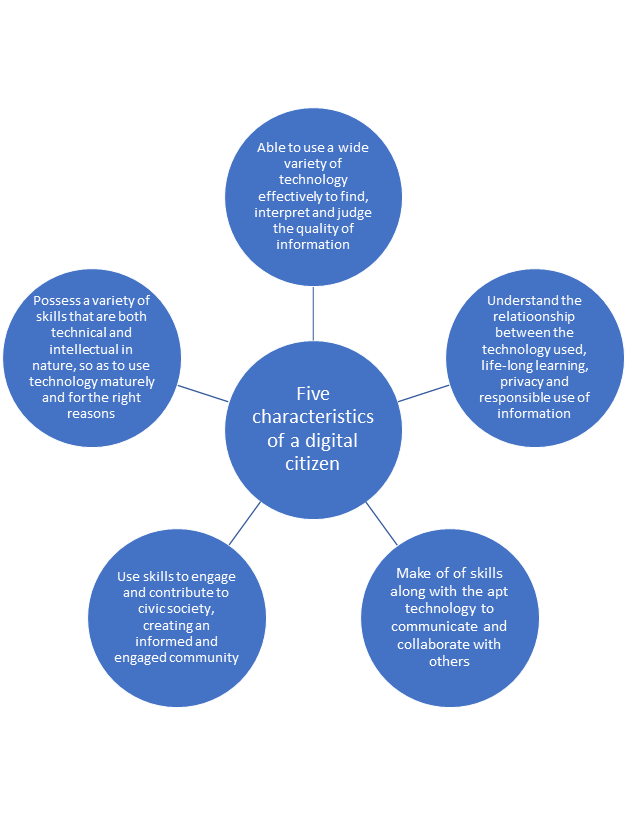
Visser (2012)
2.2.
Digital footprints are a person’s history of online behaviour and can lead to, for example, loss of jobs or job opportunities.
Our digital footprint creates the basis of our online reputation, a reputation that others may access to determine whether or not we are trustworthy, reliable, likeable, etc. We need to be very careful with our online reputation, as it is just as or even more important than our offline one. In the online world, that fixed image or text is there forever.
Digital footprints, however, can be an advantage for the sensible individual as it will only show positive things about them (The IIE, 2019).
Reference list
The IIE. 2019. Digital Citizenship [DIGC Module Manual]. The Independent Institute of Education: Unpublished.
Shea. 1994. Digital Etiquette guidelines [DIGC Module Manual].
Visser. 2012. Characteristics of a digital citizen [DIGC Module Manual]. The Independent Institute of Education: Unpublished.

